
Newborns and Sleep: How Much They Sleep, Active Sleep, Safe Sleep and What Helps
Newborns sleep a lot but in short pieces: an expert panel recommends 14 to 17 hours a day for healthy newborns, spread across day and night. About half of a newborn's sleep is active sleep, the baby version of REM, with twitches, grunts and irregular breathing that are normal. Night sleep consolidates over the first months: in a study of 75 infants, most slept through the night by 2 to 3 months on looser definitions and by about 5 months on the strictest one, with wide variation. Safe sleep comes first: on the back, on a flat firm surface with nothing else in the cot, in the parents' room for the first months. White noise can help settle some newborns, kept at about 50 dB and at least two metres from the cot.
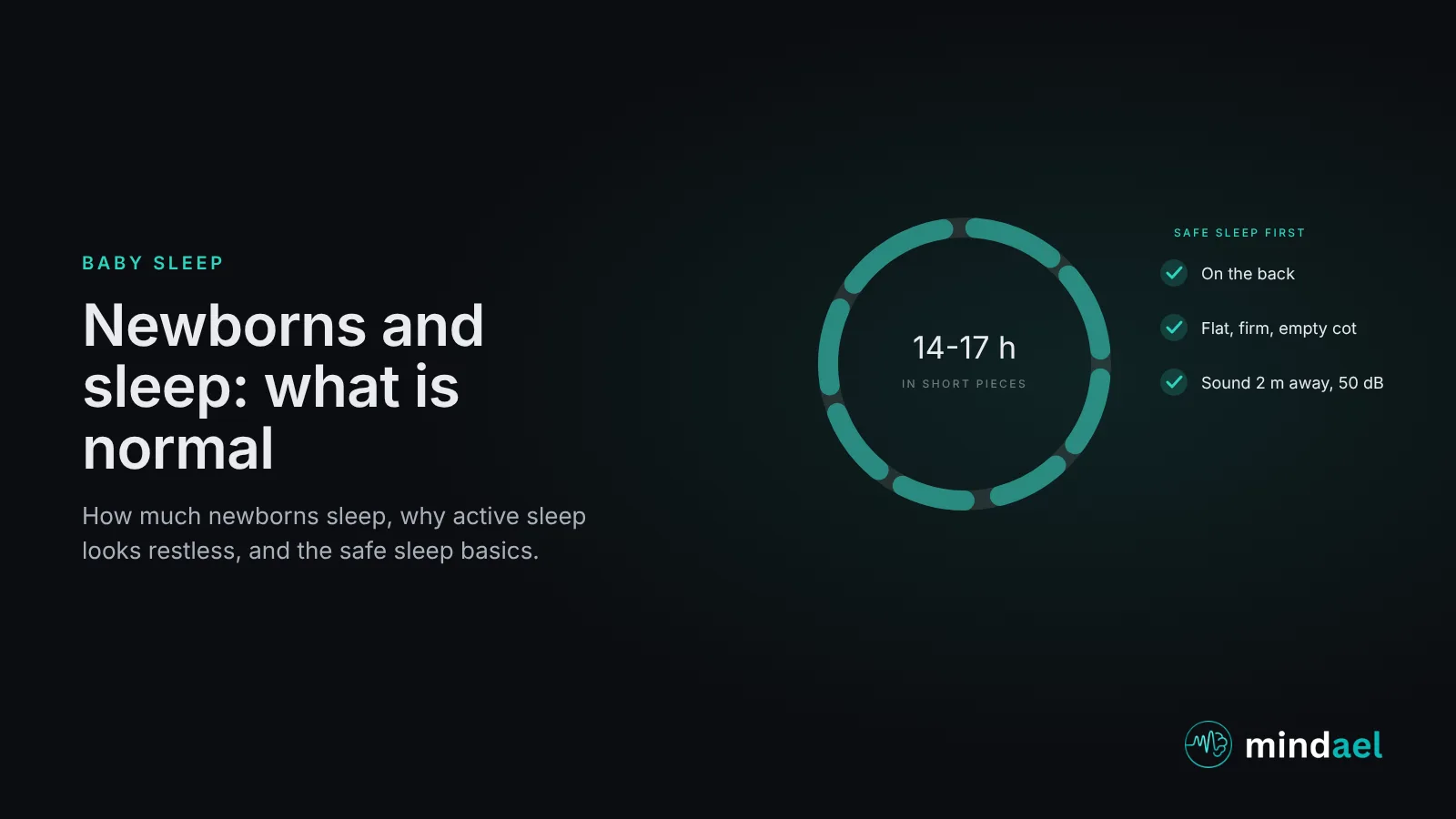
Newborns and sleep is the topic every new parent researches at 3 a.m. The short version: newborns sleep a lot, in short pieces, noisily, and that is normal. This article covers how much sleep is normal, why newborn sleep looks so restless, when longer stretches arrive, the safe sleep basics, and how a quiet sound can help. If you use sound, the steady noises we make are in Mindael, free to download on the App Store, and our white noise for babies guide has the full setup.
How much newborns sleep
A National Sleep Foundation expert panel recommends 14 to 17 hours in 24 hours for healthy newborns (Hirshkowitz et al., 2015). That sleep does not come in one block. Newborns wake every few hours to feed, day and night, and their body clock has not yet learned the difference between the two. A systematic review of observational studies found wide variation between healthy infants in total sleep and in night waking (Galland et al., 2012), so a baby who sleeps a little more or less than a friend’s is usually fine.
Active sleep: why newborns are noisy sleepers
About half of a newborn’s sleep is active sleep, the early form of REM sleep. In active sleep, babies twitch, grunt, breathe irregularly, move their eyes under closed lids and sometimes smile. It looks like waking up, and many parents pick the baby up too soon. Wait a minute or two: often the baby is still asleep and settles into quiet sleep, which is calm and still. The balance shifts over the first year toward more quiet sleep.
When babies sleep through the night
Longer night stretches come gradually. In a study of 75 infants whose parents kept sleep diaries checked against video, most were sleeping through the night by 2 to 3 months on looser definitions, about half met the strictest definition by 5 months, and by 12 months most, but not all, did (Henderson et al., 2010). Some babies who slept well at 3 months wake more again later. All of that is within normal.
Safe sleep comes first
The American Academy of Pediatrics recommendations are the basics for every sleep (Moon et al., 2022):
- On the back for every sleep, naps included.
- A flat, firm surface with a fitted sheet, and nothing else in the cot: no pillows, bumpers, blankets or toys.
- Room-sharing without bed-sharing, ideally for at least the first six months.
- No overheating and no smoke around the baby.
No sound, app or device replaces any of these.
How sound can help
A steady sound can help some newborns settle; in one early trial of 40 newborns, 80 percent fell asleep within five minutes with white noise, against 25 percent without it (Spencer et al., 1990). The catch is volume: in a study of 14 infant sleep machines, all were louder than the 50 dB nursery limit at 30 cm on maximum volume (Hugh et al., 2014). So keep any sound at about 50 dB where the baby sleeps, put the device at least two metres from the cot, never in it, and use the lowest level that works. Our white noise device article compares machines and apps, and the noise colors comparison explains when pink or brown noise suits better than white. Mindael is where we keep our steady sounds, free to download.
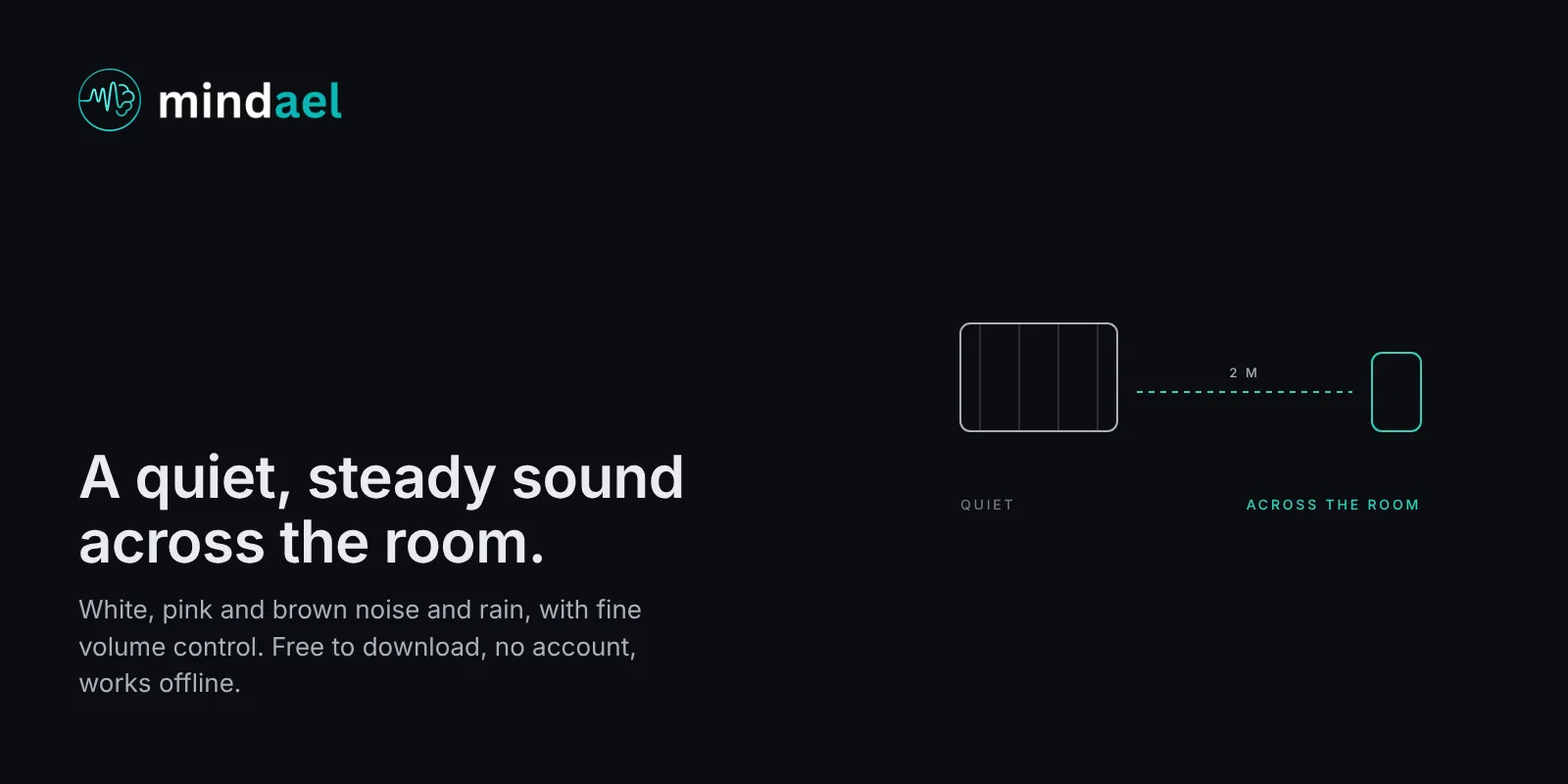
A quiet, steady sound across the room.
Mindael has white, pink and brown noise generated to spec and rain recorded without loops, with fine volume control for a low, safe level. Free to download, no account, works offline. A phone in airplane mode, two metres from the cot.
- White, pink and brown noise, and rain
- Fine volume control for a low level
- Free to download, no account, works offline
 Free · No account needed · Works offline
Frequently asked questions
How much should a newborn sleep?
An expert panel recommends 14 to 17 hours in 24 hours for healthy newborns. Sleep comes in short stretches of a few hours, day and night, because newborns need to feed often. Some healthy babies sleep a little more or less.
Why is my newborn so noisy and restless when asleep?
About half of a newborn's sleep is active sleep, the early form of REM sleep. Twitches, grunts, irregular breathing, eye movements under the lids and little smiles are all normal in this stage. Wait a moment before picking the baby up, because they may still be asleep.
When do babies sleep through the night?
It varies a lot. In a study of 75 infants, most slept through the night by 2 to 3 months on looser definitions, and about half met the strictest definition by 5 months. By 12 months most did, but not all, and that is still normal.
What are the safe sleep rules for newborns?
Back to sleep for every sleep, on a flat, firm surface, with nothing else in the cot: no pillows, bumpers, blankets or toys. Share a room, not a bed, for at least the first six months, and avoid overheating and smoke exposure.
Is white noise safe for newborns?
It can help some babies settle, if it is kept quiet and away from the cot: about 50 dB where the baby sleeps, and the device at least two metres away. Some infant sleep machines can be much louder than that at full volume.
Should I wake my newborn to feed?
In the first weeks many newborns need to be woken for feeds, especially before they are back to birth weight. How often depends on your baby, so follow the advice of your midwife, health visitor or doctor.
Sources
- Hirshkowitz M, et al. National Sleep Foundation's sleep time duration recommendations: methodology and results summary. Sleep Health, 2015.
- Henderson JMT, France KG, Owens JL, Blampied NM. Sleeping through the night: the consolidation of self-regulated sleep across the first year of life. Pediatrics, 2010.
- Galland BC, Taylor BJ, Elder DE, Herbison P. Normal sleep patterns in infants and children: a systematic review of observational studies. Sleep Medicine Reviews, 2012.
- Moon RY, et al. Sleep-related infant deaths: updated 2022 recommendations for reducing infant deaths in the sleep environment. Pediatrics, 2022.
- Spencer JA, Moran DJ, Lee A, Talbert D. White noise and sleep induction. Archives of Disease in Childhood, 1990.
- Hugh SC, et al. Infant sleep machines and hazardous sound pressure levels. Pediatrics, 2014.
This article is for general information and is not medical advice. If you are worried about your baby's sleep, breathing, feeding or weight, please talk to your midwife, health visitor or doctor.
This article is part of our baby and child sleep guide. Hear the sounds in this article in the Mindael sound library, or see our app comparison checklists.